

Maersk Signals Full Return to the Suez Canal in 2026 as Red Sea Route Comeback Enters Countdown

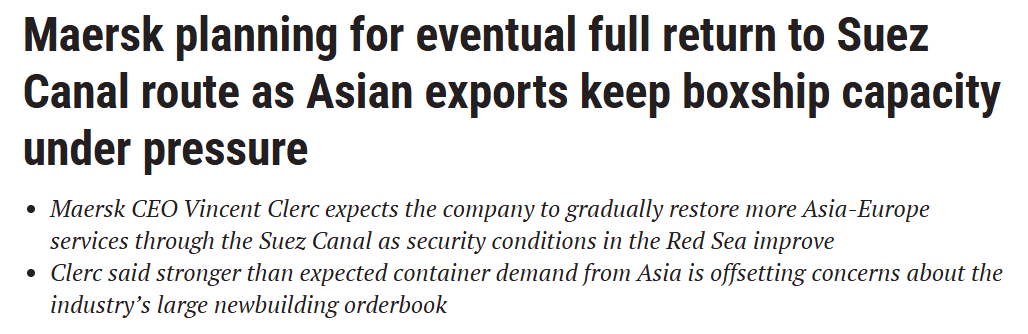
According to the latest August reports from Lloyd’s List, Reuters, Seatrade Maritime and other industry media, as the security situation in the Red Sea region continues to improve, Maersk is accelerating plans to shift its Asia-Europe services from the Cape of Good Hope route back to the traditional route via the Suez Canal.
During a second-quarter investor call on August 13, Maersk CEO Vincent Clerc explicitly stated, “Unless there is a new development in Yemen, I think the conditions are in place for a full return to the Suez Canal in 2026.”
One-Third of Traffic Has Already Returned, with Services Resuming One by One
Maersk’s return is not a sudden decision, but rather a gradual adjustment that has been underway for several months. Clerc disclosed during the call that around one-third of the company’s normal traffic has now returned to the Red Sea and Suez route, covering four of its 13 services.
The progress has followed a clear timeline. In early July, the AE15 Asia–Mediterranean service became the first to resume Suez Canal transits. The MECL service subsequently returned to the Red Sea and added a call at Jeddah. On July 13, the WAF6 service also switched back to the Red Sea route.
On August 10, under the Gemini Cooperation framework, the AE19 service officially switched from the Cape of Good Hope route back to the Trans-Suez route, with the new routing covering the Suez Canal, Jeddah and other key ports.
It is also worth noting that Mediterranean Shipping Company (MSC) has not officially announced a return. However, seven MSC vessels have passed through the Bab el-Mandeb Strait over the past two weeks, which industry analysts see as a signal that a broader return could come earlier than expected.
Landside Bottlenecks Are Becoming the New Constraint, So a Sharp Freight Rate Drop May Not Follow
Clerc emphasized during the investor call that the core constraint on shipping efficiency has shifted from vessel capacity to landside infrastructure.
Asian exports have grown by approximately 25% over the past three years, while the average vessel waiting time at the Port of Shanghai has now reached as long as 12 days. Clerc believes that even if a full return to the Suez route releases additional shipping capacity, congestion at European ports will absorb a significant portion of the newly available effective capacity. As a result, freight rates will not necessarily fall sharply.
According to Lloyd’s List Intelligence data, approximately 273 vessel transits per week were recorded through the Bab el-Mandeb Strait between July 27 and August 2, remaining relatively stable but about 15% below the level recorded in the week before Saudi Arabia announced its blockade.
However, the number of major tanker transits fell by around 40%, while the number of vessels switching off their AIS signals to conceal their movements increased significantly. This highlights the continuing uncertainty surrounding the security environment.
Risks Remain, and the Return Will Not Happen Overnight
Maersk has emphasized that the full return will be a gradual process, implemented “one service at a time.”
The main concern is that if a large number of services switch back to the Suez route simultaneously, shorter transit times could cause vessels to arrive in Europe earlier and in greater concentration, potentially worsening congestion at local terminals and across the landside logistics network.
At the same time, the Houthi blockade targeting Saudi-linked vessels remains in place, meaning the security situation is far from returning to normal.
The Joint War Committee has expanded the high-risk area in the Red Sea approximately 800 kilometers northward. Ports including Jeddah and Yanbu in Saudi Arabia have also been brought under enhanced war-risk considerations.
Industry Outlook
For China's shipping industry, the gradual return of Suez services means that Asia-Europe capacity is unlikely to be released all at once in the short term, suggesting that the freight-rate center may decline relatively gradually.
However, two trends deserve close attention.
First, congestion at Asian ports — with waiting times at Shanghai, Ningbo and Shenzhen reaching as high as 12 days — combined with bottlenecks across European and U.S. landside logistics, means that supply chain pressure is unlikely to ease quickly.
Second, competitors such as MSC and CMA CGM are also moving toward a return to the Suez route. Competition for market share could therefore accelerate downward pressure on freight rates.
Relevant companies are advised to closely monitor Maersk’s subsequent service adjustments, plan container capacity procurement and routing accordingly, and retain Cape of Good Hope routing contingency plans to hedge against the risk of renewed security disruptions.